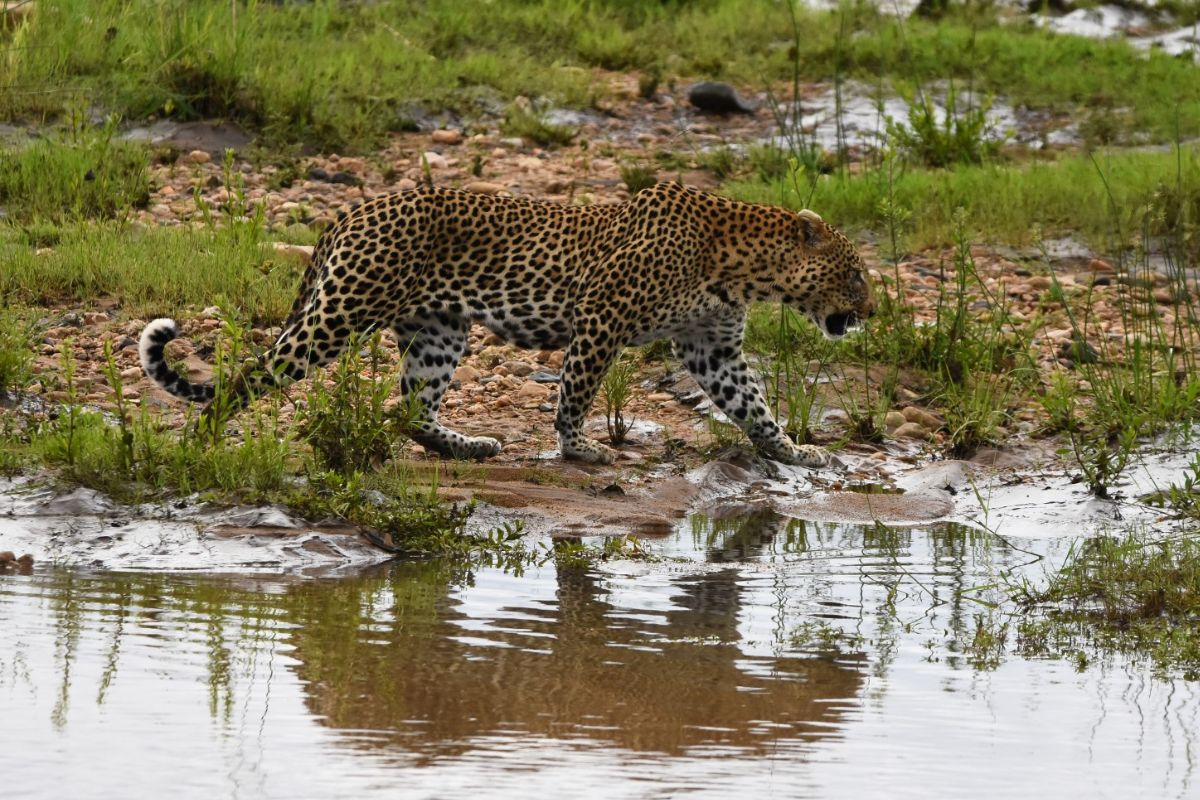
Leopards put on the spot: New research on Southern African cats
Leopards face growing pressure across southern Africa. New research in Botswana and South Africa aims to reveal how many remain.





A leopard can cross a game drive road without leaving more than a flicker of its tail. They are masters of staying out of sight, which makes counting them one of conservation’s hardest tasks.
New research across southern Africa could change that, using thousands of camera-trap images to establish where these cats remain and how many there may be.
WHY ARE LEOPARDS SO DIFFICULT TO COUNT?
The African leopard is listed as Vulnerable on the IUCN Red List as the species has disappeared from at least two-thirds of its historical range in Africa. Habitat loss, prey depletion, conflict with people, illegal killing and poorly managed hunting all add pressure.
South Africa has no recent national population figure precise enough to remove uncertainty. A SANBI assessment estimated between 2 813 and 11 632 animals, with a median estimate of 4 476. SANBI stresses that these figures came from habitat and density models, rather than a nationwide count.
That uncertainty matters: A leopard population can look healthy in one reserve while struggling outside protected areas.
In KwaZulu-Natal, research found densities falling from 11 per 100 km² inside a reserve to three on adjoining unprotected land.
WHAT ARE THE NEW NUMBERS TELLING US?
The Safari Club International Foundation’s African Leopard Research Project has just completed a three-year survey in Botswana. Researchers deployed more than 1 000 camera-trap stations across about 12 000 km².
The cameras recorded 1 424 leopard detections, and researchers identified 427 individuals from those images. That figure represents identified animals within the surveyed area, not Botswana’s entire leopard population.
The results have already had policy consequences. Botswana’s Department of Wildlife and National Parks used the findings while developing a 10-year Leopard Management Plan submitted to CITES.
The work shows why reliable numbers matter when governments make decisions about wildlife management.
The project is now moving into South Africa through a partnership between SCIF and the PHASA Foundation.
The aim is to produce comparable, science-based population data that can guide conservation and management.
WHAT DO LEOPARDS MEAN IN SOUTHERN AFRICAN CULTURES?
The leopard carries more than spots. In South Africa, the animal also carries cultural meaning.
SANBI notes that leopard skins feature in ceremonial clothing among cultural and religious groups in KwaZulu-Natal and Eswatini.
Members of the Shembe Church, for example, use leopard skins as a sign of worship. Leopard skin has also represented authority and status in Zulu culture.
There is folklore behind the animal’s name, too. SANBI notes that “leopard” combines ancient Greek words for lion and panther. This reflects an old belief that the animal was a hybrid of the two.
Today, the challenge is to protect both the animal and the cultural traditions surrounding it.
Research can provide the numbers that can help Southern Africa decide how its spotted cats survive alongside people.