United States NIH funding returns: What it means for South African scientists
The US National Institutes of Health has ended its 18-month, Trump-imposed ban on funding South African research.





The US National Institutes of Health (NIH) officially ended its controversial 18-month ban on funding for new medical research in South Africa, to resume critical scientific partnerships.
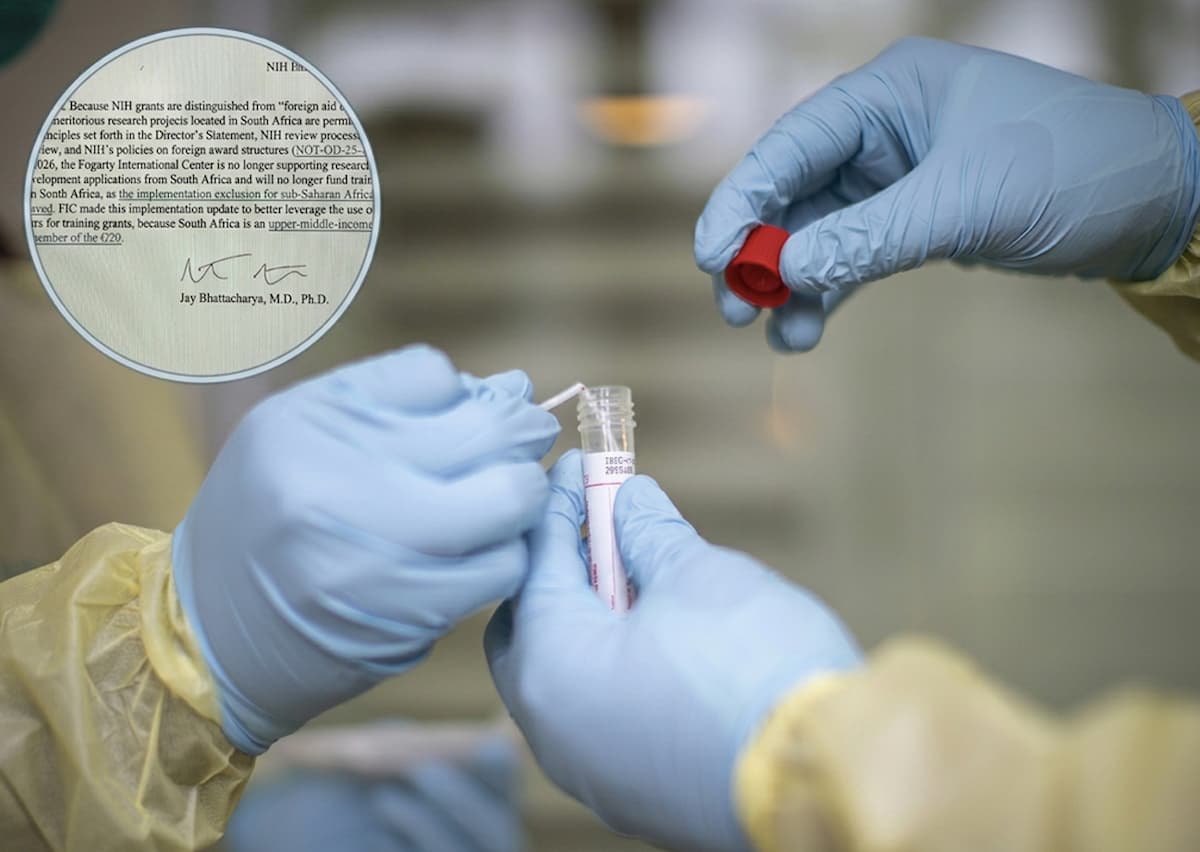
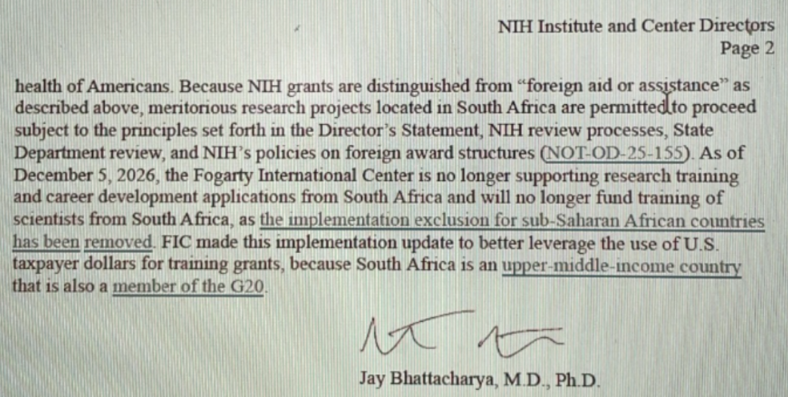
According to an internal staff memo reported by the journal Science, NIH director Jay Bhattacharya clarified that agency grants are distinct from “foreign aid or assistance”.
This distinction exempts the funding from the sweeping restrictions imposed by US President Donald Trump under Executive Order 14204 in February 2025.
Why was NIH funding suspended?
Trump’s executive order halted all American foreign aid to South Africa, citing Pretoria’s land reform policies and its genocide case against Israel in the International Court of Justice.
The ban threw local research units into turmoil, forcing them to suspend crucial trials and retrench highly skilled medical staff.
Medical Research Council president Ntobeko Ntusi previously estimated that the loss of US support, including separate cuts to the President’s Emergency Plan for AIDS Relief (PEPFAR), cost South Africa almost $450 million (R7.4 billion).
In June 2026, Health Minister Aaron Motsoaledi, described the PEPFAR withdrawal as a “wakeup call” for South Africa, to “stand on our own”.
Local scientists are overjoyed by the decision. Glenda Gray, a paediatrician at the University of the Witwatersrand who lost several clinical trial grants for HIV and tuberculosis (TB) research, expressed her profound relief: “It’s a huge deal. I am almost crying.”
Linda-Gail Bekker, director of the Desmond Tutu Health Foundation, described the restoration of NIH funding as a “lifeline to rebuild”.
The catch behind the new NIH funding
Despite the relief, Bhattacharya’s memo contains a sting in the tail. South African scientists are now excluded from the NIH’s Fogarty International Center training and career development grants.
Bhattacharya justified this by noting that South Africa is an upper middle-income country and a G20 member.
Salim Abdool Karim, director of the Centre for the AIDS Programme of Research in South Africa, called this exclusion “unfortunate” and a “self-inflicted wound”.
He warned that Fogarty support was vital for early-career scientists. Additionally, future applicants must convince the NIH that their research will directly improve American healthcare, creating additional bureaucratic hurdles.
Because of these new rules and the complex approval processes, researchers warn that the first new grants may not be awarded until next year.
Is Trump administration funding research into Afrikaner ‘victimisation’?
The lifting of the NIH-funding ban coincides with recent reports of a plan to direct $1 million of US foreign aid to fund controversial research into crimes against white Afrikaner farmers.
According to an investigation by New York-based publication ProPublica, a deputy assistant secretary of state has been directed to award the funds.
Lex Libertas – a South African group whose stated aim is a “new political dispensation in which the diverse communities of South Africa are free to govern themselves” – will reportedly receive the money.