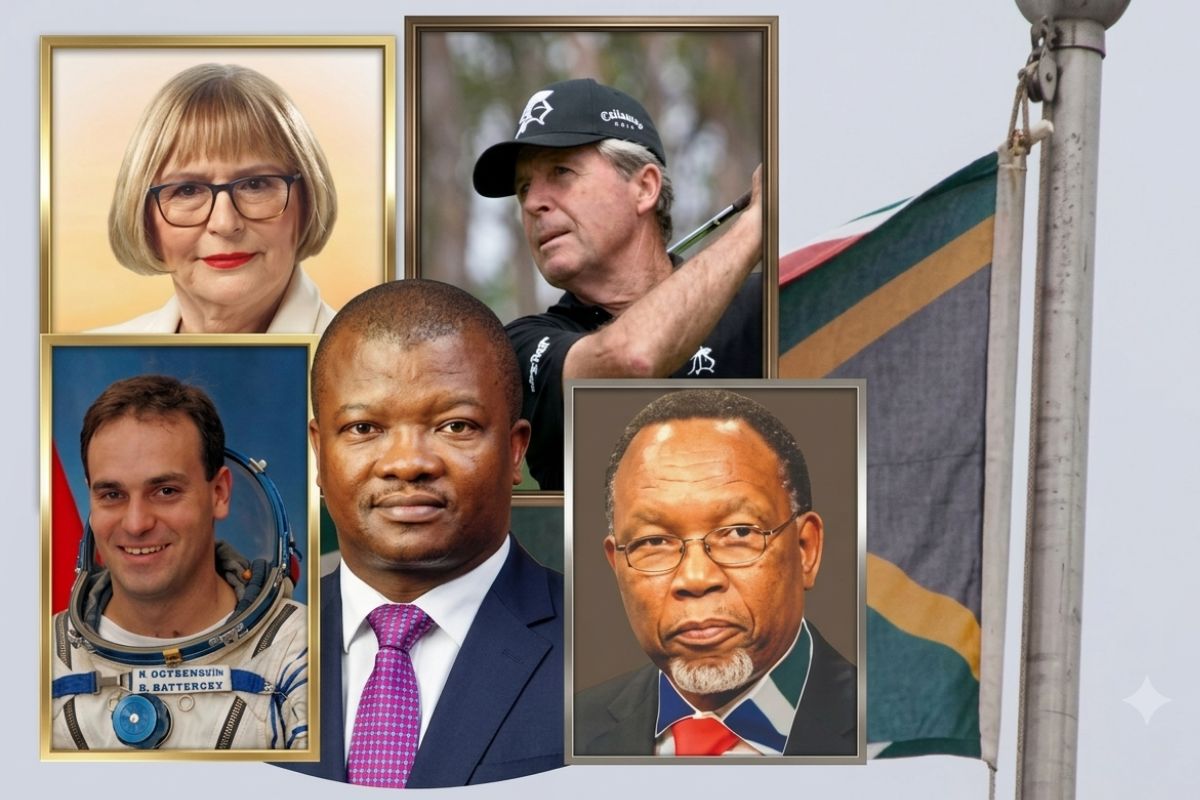
Well-known South Africans from yesteryear: Where are they now?
Discover what a few well-known South Africans who once dominated headlines are doing today, from politics to sport and literature.





Certain names instantly transport us to another era. Once their faces filled newspaper front pages, interrupted evening television bulletins and sparked debates around countless braais and family tables.
Then the spotlight shifted from these well-known South Africans.
New stories took over, and many of those familiar personalities quietly slipped from daily view. Yet disappearing from the headlines does not mean disappearing altogether.
Many of them continue to write, teach, govern, compete and inspire, with the same purpose as when we watched their every move.
WHICH WELL-KNOWN SOUTH AFRICANS ARE STILL MAKING AN IMPACT?
Some have exchanged public office for quieter influence, while others remain active on the world stage.
Dr Mamphela Ramphele first became known as a leader of the Black Consciousness Movement alongside Steve Biko during the 1970s.
She later broke barriers as the first Black vice-chancellor of the University of Cape Town and also held a senior leadership position at the World Bank.
Today she continues to write and speak on African governance. Only weeks ago, she reflected on Nelson Mandela’s legacy in an interview with Forbes.
J.M. Coetzee followed a different path. The double Booker Prize winner and recipient of the 2003 Nobel Prize in Literature has lived in Australia for more than two decades, but his voice still carries weight.
Earlier this year, he again drew international attention after declining an invitation to a literary festival because of the war in Gaza.
Former finance minister Trevor Manuel helped steer South Africa’s economy through the country’s early democratic years. Although he stepped down as chair of Old Mutual, he remains an influential advocate for debt reform and economic development across Africa.
FROM THE SPORTS FIELD TO A LIFELONG PASSION
Several sporting legends also prove that retirement rarely means standing still.
Gary Player’s achievements remain almost unmatched. Between 1959 and 1978, he won nine major championships and became one of only five golfers to complete the career Grand Slam.
At 90, he still travels internationally, designs golf courses and appeared at PGA Championship events this year, including celebrations marking his famous 1962 victory.
Many people also remember the dramatic 3 000 metre final at the 1984 Los Angeles Olympics, when Zola Budd collided with American runner Mary Decker.
More than 40 years later, Budd still enjoys competitive running. Recently she lined up for a 10 kilometre race in Paarl. And she still trains athletes.
WHY THESE WELL-KNOWN SOUTH AFRICANS STILL MATTER
Public service has also remained central to several familiar names.
Helen Zille first entered the national spotlight after exposing the truth about Steve Biko’s death in detention as a young journalist. She later became mayor of Cape Town, premier of the Western Cape and leader of the Democratic Alliance.
This year she stepped down as the party’s federal chair to campaign for the Johannesburg mayoralty.
Former president Kgalema Motlanthe continues to be regarded as one of the country’s respected elder statesmen. Last year he delivered a lecture on South African democracy at the University of Pennsylvania.
Bantu Holomisa, who helped negotiate South Africa’s democratic transition before founding the United Democratic Movement in 1997, now serves as Deputy Minister of Defence and Military Veterans.
And Mark Shuttleworth, who remembers him as the first African in space?
He sold his internet security company in 1999 for close to $600 million, then used part of that fortune to fly to the International Space Station in 2002.
He founded Ubuntu and its parent company, Canonical, in 2004. Canonical announced a partnership with NVIDIA at Computex 2026 to build AI-agent support into Ubuntu.
He also runs a venture capital operation and funds a biodiversity stipend programme for residents of Principe Island off West Africa.
Their stories offer a reminder that influence is not measured only by headlines. Many of these people who once dominated the news cycle are still shaping the country’s future, albeit far from the glare of cameras.