‘Cooperation with governments of concern to US’: Read Trump’s AGOA letter to Ramaphosa
Washington has set a 1 January 2027 exit date over diplomatic and trade friction, but agricultural economist Wandile Sihlobo insists South Africa faces no economic catastrophe.





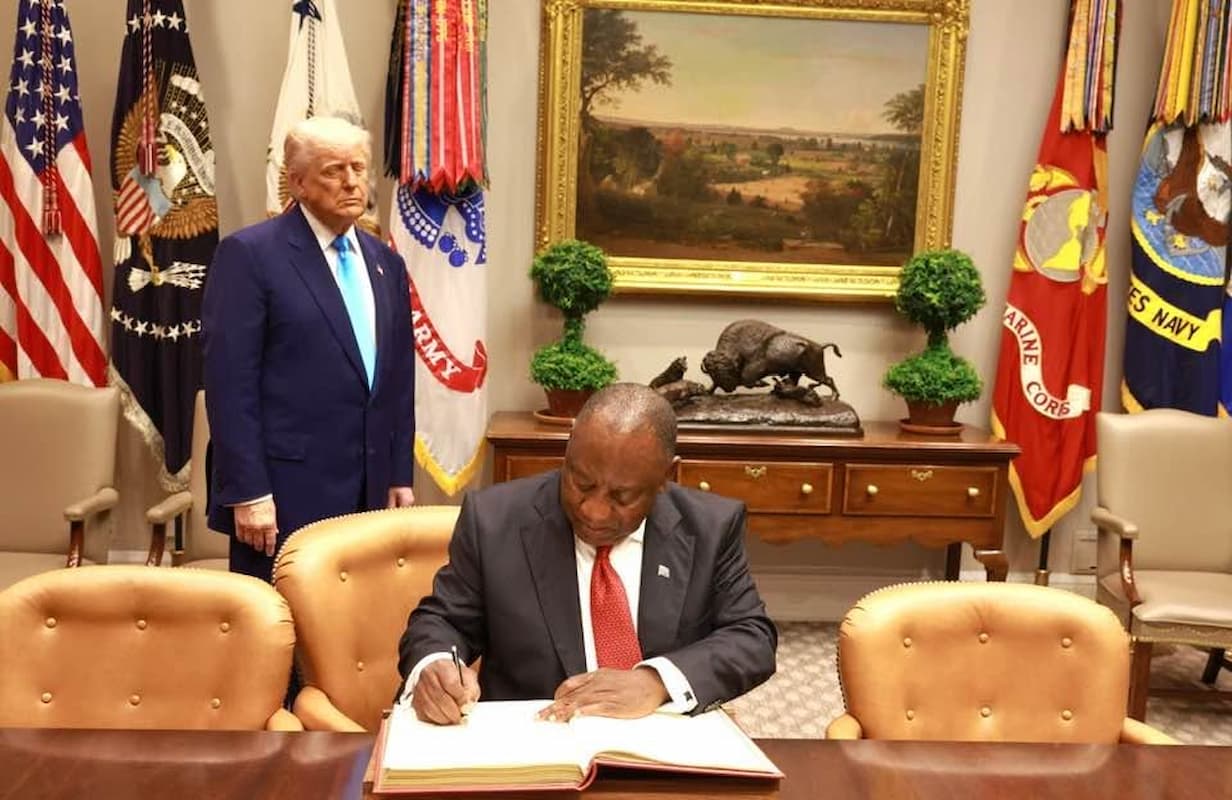
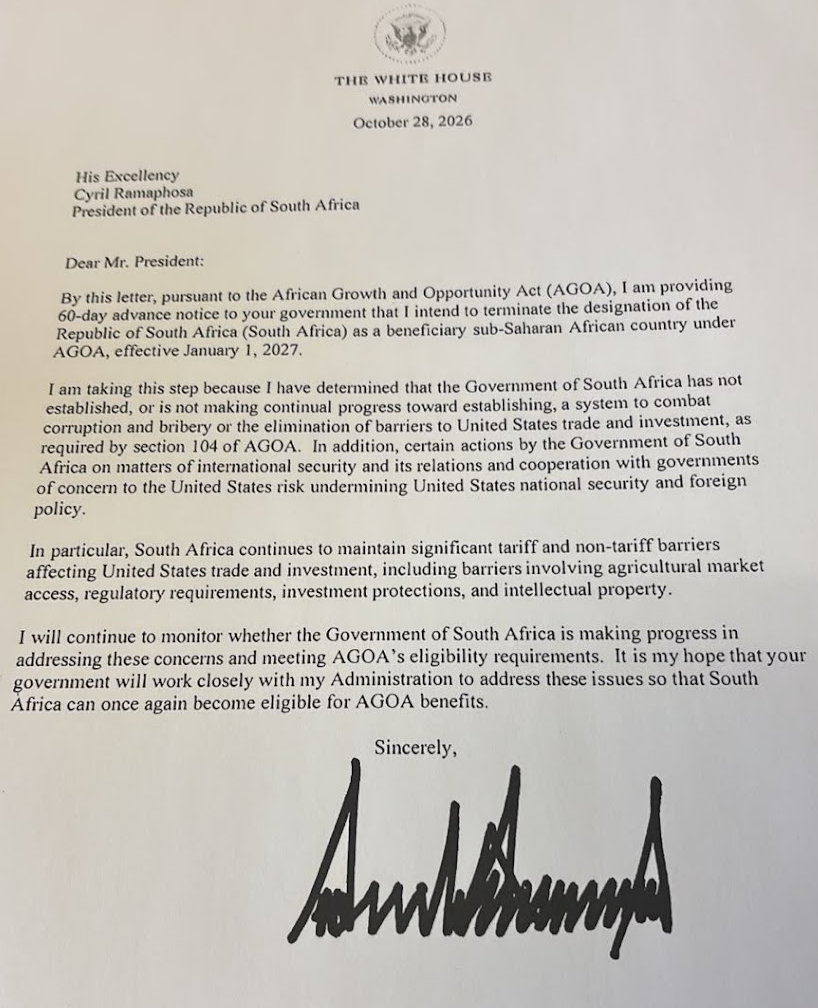
United States President Donald Trump has officially notified President Cyril Ramaphosa of his intention to terminate South Africa’s duty-free trade access under the African Growth and Opportunity Act (AGOA), effective 1 January 2027.
In a White House letter dated 28 October 2026, Trump delivered the 60-day advance notice, saying that South Africa had failed to establish continuous progress toward combating corruption or eliminating barriers to American trade and investment under Section 104 of AGOA.
Trump also highlighted foreign policy friction, writing that “certain actions by the Government of South Africa on matters of international security and its relations and cooperation with governments of concern to the United States risk undermining United States national security and foreign policy”.
He also cited tariff and non-tariff barriers affecting agricultural market access, regulatory requirements, and intellectual property protections.
US ambassador’s past statements foreign policy choices
The move follows confirmation by US Trade Representative Jamieson Greer regarding South Africa and Rwanda’s pending removal from the programme.
United States Ambassador to South Africa, Leo Brent Bozell III, later described the decision on X as a “predictable and preventable outcome” resulting from Pretoria rejecting American concerns.
Bozell had previously condemned Pretoria’s non-aligned stance after South Africa hosted Iranian Deputy Foreign Minister Saeed Khatibzadeh while Deputy President Paul Mashatile deepened ties in Beijing. That public outburst defied a warning from Ramaphosa urging foreign envoys to avoid public confrontation.
Economic buffers and market reality
Speaking last Thursday, Trade, Industry and Competition Minister Parks Tau said that South Africa’s economy remained resilient, noting that roughly 89% of exports to the US already enter under standard World Trade Organization terms.
Preferential AGOA exports account for $1.7 billion (about R28 billion), representing 10% of bilateral shipments and 1% of total global exports. Total bilateral trade reached $28.8 billion (about R475 billion) in 2025, supporting 134 600 local jobs across 600 American companies, said Tau.
He added that local exporters already faced Section 232 duties on vehicles and steel, alongside Section 301 tariffs.
Wandile Sihlobo, Presidential Envoy on Agriculture and Land and chief economist at the Agricultural Business Chamber of South Africa, stressed that exclusion from AGOA is not a trade ban.
Sihlobo explained that affected products face an additional Most Favoured Nation tariff of around 3.4%, raising Liberation Day tariffs from 12.5% to 15.9%.
“While this would be a challenging path, it would not necessarily be as catastrophic as we have faced in the past,” Sihlobo noted.
He highlighted that South Africa exported $504 million in agricultural goods to the US in 2025 despite temporary 30% tariffs. The US accounts for 4% of South African agricultural exports, including citrus, wine, table grapes and nuts.
Sihlobo urged accelerated market diversification to Asia and the Middle East rather than panic.
Meanwhile, Pretoria is expanding trade across the African Continental Free Trade Area, SADC, and the European Union, with Germany recently surpassing the US as South Africa’s second-largest trade partner.