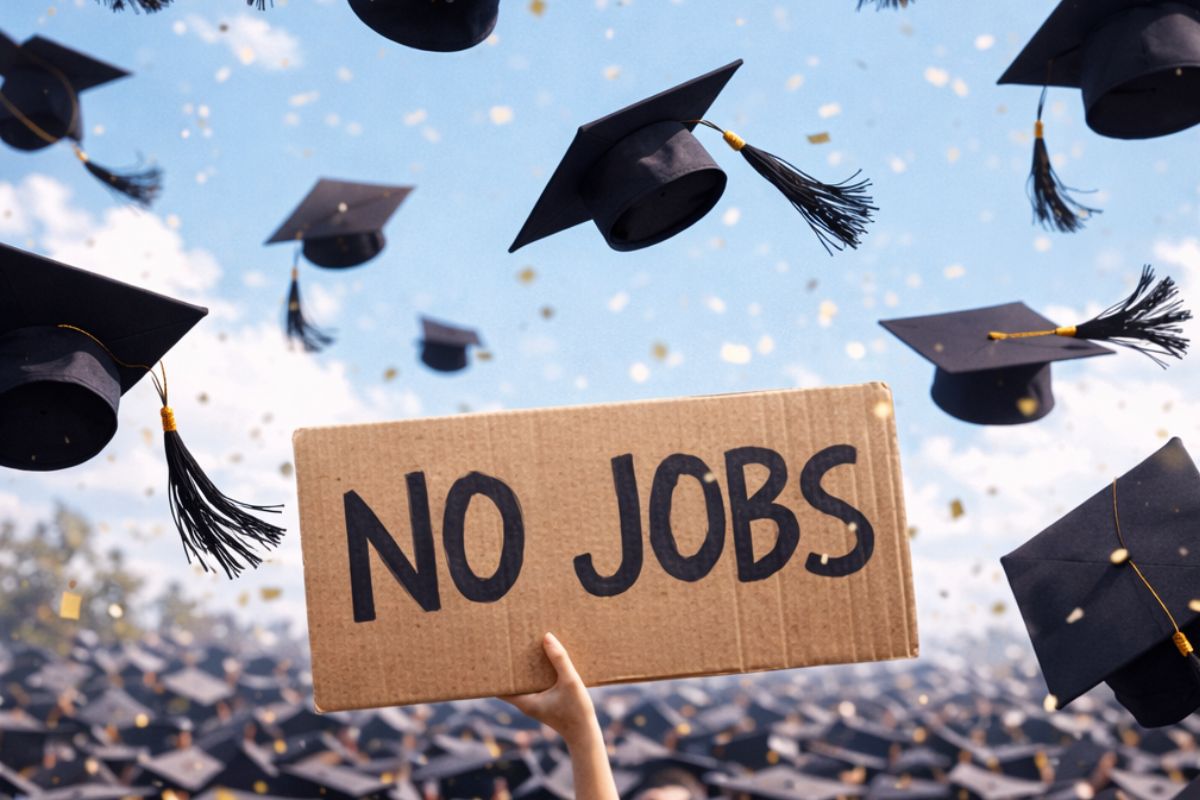
Graduate unemployment in SA: The overqualified crisis
SA graduates are more qualified yet more unemployed than ever. We explore the ‘experience trap’ and the crisis of graduate unemployment.

For many, the walk across the graduation stage is supposed to be the start of a professional career. Instead, it has become the start of a long and lonely search. Whether you graduated last month or five years ago, the reality of graduate unemployment in South Africa is a shared burden.
We are witnessing a historic paradox: a generation that is more qualified than ever, yet increasingly locked out of the workplace.
Structural reality of graduate unemployment in South Africa
The crisis is not a reflection of your worth; it is a systemic failure. Personally, as a recent graduand, I have felt this weight firsthand. I have lost count of the number of applications I’ve sent out, each one representing hours of effort and hope, only to be met with total silence or automated rejections.
- The “Waithood” Phase: Many graduates now spend 2 to 4 years in this limbo.
- The Volume: Sending dozens of tailored CVs a week has become a full-time, unpaid job.
- The Statistics: Data from 2026 shows that even with a degree, the path to a first paycheck is no longer guaranteed.
The experience gap as a barrier to entry
The biggest driver of graduate unemployment in South Africa is the “Experience Trap”. It is the frustration of seeing an entry-level job that demands 3 to 5 years of experience.
- The Logical Loop: You need a job to get experience, but you need experience to get the job.
- The Stale Factor: Those who graduated a few years ago are often overlooked, leaving them stuck in the middle.
- The Risk: Companies would rather leave a seat empty than spend money training a fresh graduate.
Academic inflation and graduate unemployment in South Africa
Because a Bachelor’s degree no longer feels like enough, many are heading back to university out of necessity rather than choice. I see this clearly among my own circle – for many of my friends, their only remaining option is to study for an Honours degree or a different qualification simply because they cannot find work.
- The Mismatch: You end up “overqualified” for junior roles, yet you still lack the practical “on-the-job” skills employers demand.
- The Debt: This extra studying adds financial pressure to an already stressful situation.
Solving graduate unemployment in South Africa
To fix this, we need a shift in how the country views new talent.
- For Employers: They must stop using “years of experience” as a lazy filter. We need more “potential-based” hiring and mentorship programs.
- For Graduates: While the system is broken, we are forced to adapt. Moving toward “skills-based” resumes and micro-certifications is becoming the only way to prove competence where formal experience is lacking.