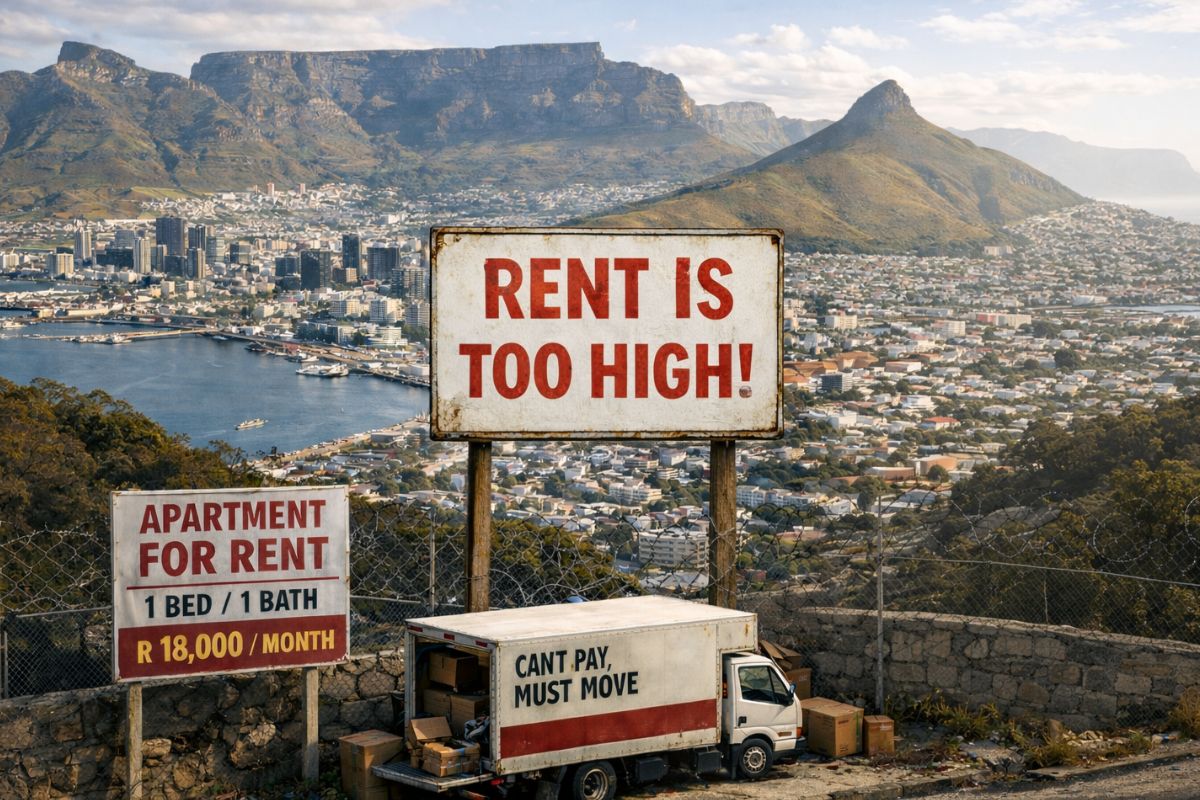
Cape Town rent: Is the Mother City only for tourists?
Rising Cape Town rent is pushing locals out as Airbnbs take over. Can the city survive if its workers can’t afford to live there?

Can a city truly thrive when the people who build, clean, and run it can no longer afford to live in it? In January 2026, this difficult question hangs over the Atlantic Seaboard as the Mother City grapples with a profound identity crisis.
While it remains a global jewel for tourism and remote work, the local workforce is facing a “rental wall” that threatens the city’s social fabric. Central to this struggle is the skyrocketing Cape Town rent, which has decoupled from local earnings at an alarming rate.
The reality of Cape Town rent in 2026
As of early 2026, the average Cape Town rent for a one-bedroom apartment in the city center has climbed to approximately R13,000 to R15,000 per month. For a middle-class household earning the median income of roughly R14,100, this cost is effectively a barrier to entry.
While national inflation has hovered around 4.5%, the cost of living in the Western Cape has seen much sharper spikes. Specifically, Cape Town rent in prime hubs like Sea Point and the City Bowl increased by nearly 30% year-on-year leading into 2026. This has created a “two-speed” market: one for international digital nomads and another for locals who are increasingly pushed to the outskirts.
Why Cape Town rent is Pushing Out Locals
The primary driver of the current crisis is the sheer lack of long-term housing stock. A 2025 city report revealed that a staggering 70% of residential units in the CBD are now dedicated to short-term letting platforms or “aparthotels”.
This “touristification” means that even as new developments rise, they are rarely built for those who work in the city.
The 30% Rule is Dead: Historically, spending 30% of your income on housing was the benchmark for financial health. In 2026, the average local would need to spend over 80% of their salary to cover a central Cape Town rent agreement
The Displacement Effect: As professionals are priced out of the Atlantic Seaboard, they move into historically affordable areas like Woodstock and Salt River. This ripple effect drives up Cape Town rent in those neighbourhoods, displacing long-standing communities further away from their places of employment
Average Monthly Costs by Area (January 2026)
| Neighbourhood | 1-Bedroom Apartment | 2-Bedroom Apartment |
| City Bowl / Foreshore | R14,000 – R19,000 | R25,000 – R32,000 |
| Atlantic Seaboard | R18,000 – R25,000 | R35,000 – R55,000 |
| Southern Suburbs | R10,000 – R14,000 | R16,000 – R22,000 |
| Northern Suburbs | R8,500 – R11,000 | R13,000 – R17,000 |
Short-Term rentals and Cape Town rent hikes
The explosion of short-term rental listings – now exceeding 26,000 active units, has significantly reduced the supply of permanent homes. For property owners, the math is simple: a furnished unit can often generate the equivalent of a monthly Cape Town rent in just one week during the peak summer season.
With the official launch of the South African Digital Nomad Visa, thousands of high-earning remote workers have entered the market. These visitors, often earning in dollars or euros, view a R25,000 monthly bill as a bargain. However, for a local teacher or nurse, this price point makes Cape Town rent a source of constant financial anxiety.
Can locals still manage Cape Town rent?
For the majority of the working population, the city is becoming “unmanageable”. The “hidden tax” of being priced out is the commute; workers are now spending up to three hours a day and a significant portion of their remaining budget on transport from areas where Cape Town rent is lower.
The City of Cape Town is currently debating new regulations to mitigate this, including:
- Commercial Rating: Reclassifying properties used exclusively for short-term rentals to pay higher commercial rates.
- Inclusionary Zoning: Requiring new inner-city developments to set aside a percentage of units for affordable Cape Town rent brackets.
Rent Control Proposals: Activists are calling for caps on annual increases in specific “protected” residential zones to prevent sudden displacement.
The Road Ahead for Residents
Cape Town is at a crossroads. While the influx of global capital is an economic boon, it cannot come at the cost of the people who make the city function. Without structural intervention, the high cost of Cape Town rent will continue to turn the inner city into a playground for visitors while the local workforce is left on the periphery.