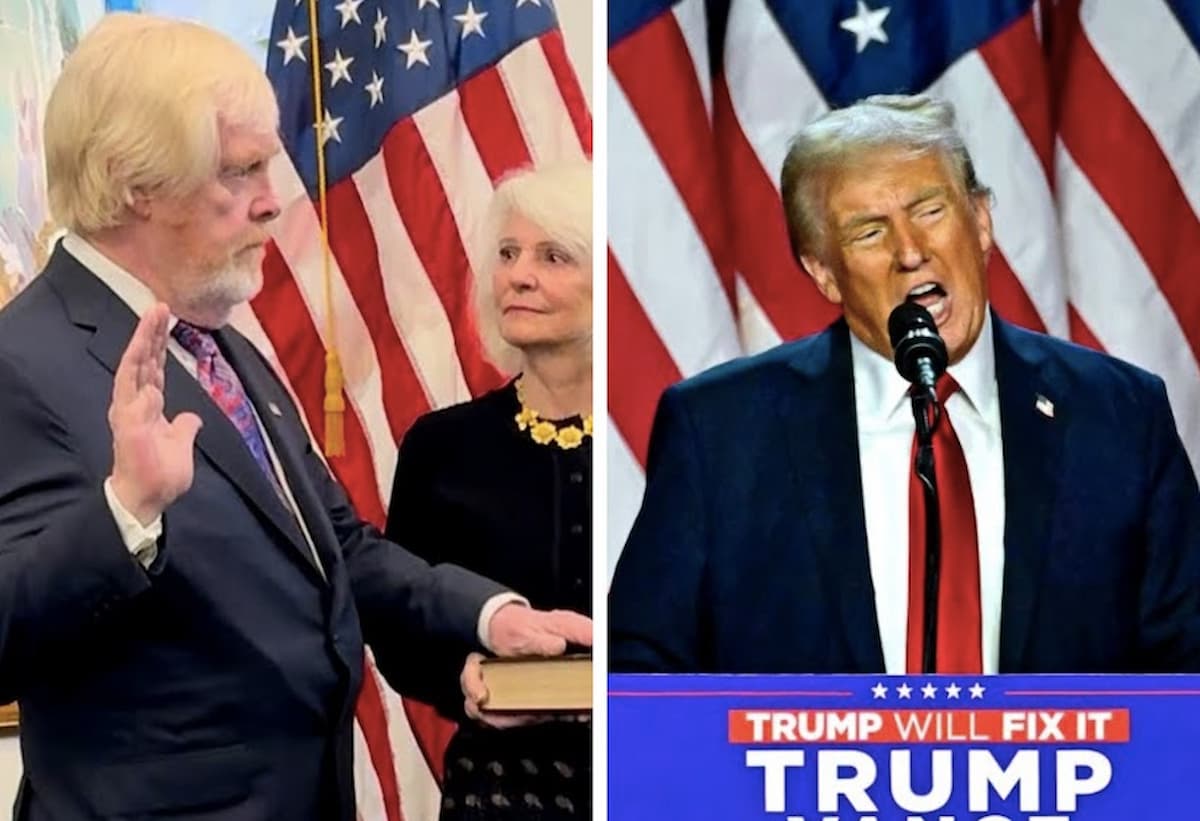
Who is US ambassador-designate to South Africa, Leo Brent Bozell III?
Bozell’s rhetoric has frequently drawn fire from critics, who accuse him of racism, notably for slyly describing Barack Obama as a ‘skinny ghetto crackhead’.

Leo Brent Bozell III has officially been sworn in as the United States ambassador-designate to South Africa during a period of unprecedented diplomatic friction between the two countries.
The 70-year-old conservative activist and media critic was confirmed by the US Senate on 18 December 2025, by a narrow party-line vote of 53-43. His arrival in Pretoria will follow the expulsion of South African envoy Ebrahim Rasool, who was declared persona non grata after labelling President Donald Trump a “white supremacist”. last year
Ambassador Bozell: Media watchdog and activist
Scion of the influential Buckley political family, Bozell’s career has been defined by his role as a leading figure in the American conservative movement.
In 1987, he founded the Media Research Center (MRC), an organisation dedicated to identifying and combating perceived liberal bias in the press. He later expanded his influence by establishing the Parents Television Council in 1995 to promote “decency” in entertainment.
However, Bozell’s professional history is dogged by a significant ghostwriting scandal. In 2014, former employees and colleagues revealed that Bozell had not written his own syndicated columns or books for years, instead relying on a colleague, Tim Graham, to pen the material.
His tenure at the Parents Television Council was also marked by controversy when the organisation was forced to pay a $3.5 million libel settlement to the WWE for false claims regarding the influence of professional wrestling on childhood violence.
A fraught history with the ANC
Bozell’s relationship with the African National Congress (ANC) is historically antagonistic. In 1987, he was a member of the Coalition Against ANC Terrorism, an alliance that opposed US diplomatic engagement with anti-apartheid leaders.
And in 2013, he purportedly claimed that the media “mythologises” Nelson Mandela, although during his confirmation hearing, he stated that Mandela is the most “revered” person in South Africa.
His rhetoric has frequently drawn fire from critics who accuse him of racial animosity, notably for slyly once describing Barack Obama as a “skinny ghetto crackhead“.
During his recent confirmation hearing, Bozell drew sharp rebukes from Democratic senators for evading questions on whether he would support the reinstitution of race-based voting laws or white-only refugee policies in the United States.
Adding to his complex profile, his son, Leo Brent Bozell IV, was convicted for his role in the January 6 Capitol attack, though he was later granted a presidential pardon by Trump.
AGOA face-off amid Bozell arrival
Economically, Bozell arrives as South Africa’s trade privileges hang in the balance.
While the US House of Representatives recently passed the AGOA Extension Act to renew the trade pact until 2028, the country faces a precarious Senate face-off. Republican Senator John Kennedy has questioned Pretoria’s eligibility, describing the nation as “buddies with all of our enemies”.
In addition, US Trade Representative Jamieson Greer has indicated a willingness to consider “separating” South Africa from the pact or imposing “different treatment”. This trade uncertainty is exacerbated by a 30% reciprocal tariff on all South African goods confirmed by the Trump administration.
Demands for a ‘geostrategic shift’
Experts warn that Bozell’s appointment signals a more volatile diplomatic arena. He has explicitly stated his intent to counteract South Africa’s “geostrategic drift” toward BRICS, in particular Russia, China and Iran.
His stated priorities include pressuring Pretoria to withdraw its genocide case against Israel at the International Court of Justice (ICJ) and demanding that the government rescind plans for property expropriation without compensation.
Whether Bozell’s presence as ambassador will mend or further fracture bilateral ties remains a critical question for President Cyril Ramaphosa’s administration.